
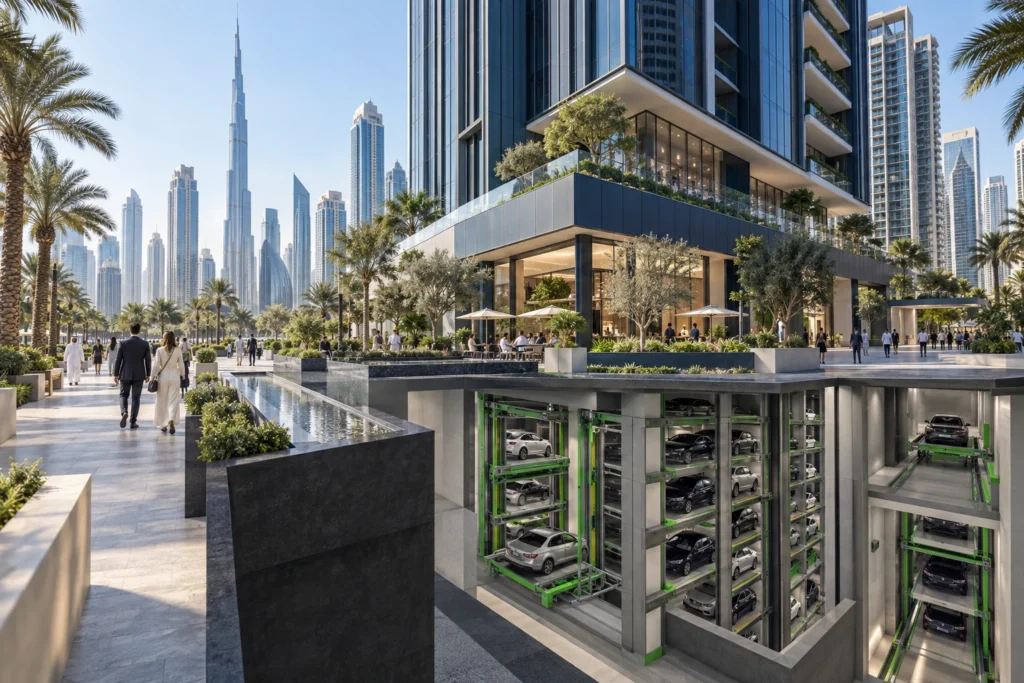
In most buildings in this region, parking is the largest single use of floor area that earns nothing. On a constrained plot it is usually also the reason the scheme does not work — the ramp will not fit, the basement goes one level too deep, or the bay count comes up short against the requirement.
A conventional car park solves that by spending area: lanes to drive down, room to turn, and a ramp to get between levels. On a large site nobody notices. In Dubai, where the plot is the constraint, it is the difference between a scheme that works and one that does not.
Automated parking removes most of that area by taking the driver out of the car park. Platforms, shuttles and lifts move the cars instead, under sensor and PLC control, so the space that would have been driven through can hold cars — or stop being built at all.
From residential buildings and commercial centres to airports and smart cities, automated parking solutions are becoming an essential part of modern urban development. What follows is what that changes — and, at the end, what it does not.
Where the space actually goes
The bays are not the problem. Everything around them is.
A conventional parking facility requires large areas for:
- Driving lanes
- Vehicle turning spaces
- Ramps
- Pedestrian pathways
- Safety zones
Every one of those is necessary in a car park people drive through, and every one of them is floor area that holds no cars.
Take the driver out and most of it is no longer needed. That is the whole argument, and the rest of this article is detail.
What is an automated parking system?
An automated parking system uses mechanical equipment, sensors, software and automation to park and retrieve vehicles without the driver searching for a space.
Instead of entering a parking garage and driving through multiple levels looking for an available spot, drivers simply leave their vehicle at a designated area. The system then moves the vehicle safely into an available parking position.
When the driver wants the vehicle back, the system locates it and returns it to the pickup area.
The four types we build are:
- Car lifts — two or three cars in the space of one
- Pit parking systems — cars stored below the surface, nothing visible at ground level
- Stack parking systems, also called puzzle parking — platforms that move up and sideways across two to sixteen levels
- Robotic parking systems — pallet-less shuttles that lift each car from underneath
Each system is configured around the project requirements, the available space, the building design and the capacity you need.
How automated parking systems work
Vehicle entry and detection
The process begins when a vehicle enters the designated parking area. Sensors and scanning technologies read what they need, including vehicle dimensions and positioning.
Automated vehicle movement
After the driver steps out, platforms, lifts or robotic shuttles move the vehicle into the assigned space.
Space management
The control system manages available positions continuously. It determines the most efficient location for each vehicle based on capacity, accessibility and retrieval requirements.
Retrieval
When a driver requests their vehicle, the system identifies its location and returns it to the pickup area. Retrieval takes around 90 seconds on a pit or stack system, and 90 to 180 seconds on a robotic one, depending on configuration.
Key benefits
Maximum use of limited space
Up to three times as many cars in the same footprint, compared with a conventional ramped car park on the same plot. The actual figure depends on site dimensions and system choice.
This makes automated systems suited to:
- High-rise residential buildings
- Commercial developments
- Hotels
- Shopping centres
- Urban redevelopment projects
Reduced traffic and congestion
Searching for parking is a major contributor to urban congestion. Drivers often spend several minutes circulating through parking areas looking for available spaces.
In an automated system there is nowhere to circulate. The car is handed over at the entry bay and the driver walks away.
Improved safety and security
Conventional parking areas can experience vehicle collisions, unauthorized access, parking damage and poor visibility.
In an automated system nobody is in the parking area at all. The storage area is sealed or inaccessible during operation, and only the person who parked the car can call it back:
- Reduced risk of vehicle damage
- Limited unauthorized access
- Better monitoring
- Improved user safety
Enhanced user experience
Drop the car at the door, walk in. Call it back, drive out. That is the whole of it:
- Quick vehicle drop-off
- Simple retrieval process
- Reduced walking distance
- Less stress during busy periods
Where the technology sits
Automated parking is an important part of smart city development. Modern systems can integrate:
- Smart sensors
- Cloud-based monitoring
- Mobile applications
- Digital payment solutions
Remote monitoring is the one that matters day to day. We watch our installed systems from our own screens and generally see a fault before the building manager does.
Environmental benefits
Lower vehicle emissions
Conventional parking requires drivers to spend time searching for available spaces, which increases unnecessary fuel consumption.
Reduced construction requirements
Because automated systems need less space than conventional garages, they reduce the land required for parking infrastructure. That land can be used for other things — green space, commercial area, community facilities.
Energy-efficient operations
Many modern automated parking solutions are designed with energy efficiency in mind. A sealed pit or an enclosed stack structure also needs far less lighting and ventilation than an open deck of the same capacity.
Why developers are choosing automated parking
Parking availability has a direct effect on property value and on how a building is experienced. For residential towers, commercial buildings and mixed-use developments, automated parking offers:
- More parking spaces in limited areas
- Better architectural flexibility
- Increased property value
- Improved building efficiency
- A better experience for residents, staff and visitors
What it does not change
Everything above is the case for automated parking. Here is the other side, because a supplier who only gives you one is not much use when you are deciding.
It does not reduce the number of cars. Demand is set by the units and the tenants, not by how the cars are stored. An automated system changes where they go, not how many arrive.
It does not remove the queue at the plot entrance. Throughput at the peak is governed by the number of entry bays, not by total capacity, and a traffic study is still required. A building that empties in fifteen minutes needs to be designed for that from the start.
It does not make parking free to run. It replaces the running costs of a conventional car park — lighting, ventilation, deck repair, security, cleaning — with a maintenance contract. That is a real cost. It is simply a more visible one, because it arrives as an invoice rather than as floor area you never notice you are paying for.
It does not suit every site. Ample land, low density and a low land value all favour a conventional ramped car park, and we would say so. If the plot is not the constraint, automation is solving a problem you do not have.
It does not fix a bad layout. If the structural grid is wrong for the bay geometry, or the clear height is short, that has to be resolved on the drawing before any system is specified.
Conclusion
Automated parking gives a building back the area a car park spends on driving. On a tight plot that is usually the difference between a scheme that works and one that does not. On a generous one it may not be worth doing, and we will tell you that.
Send us the layout and we will tell you which it is. Request a layout review