
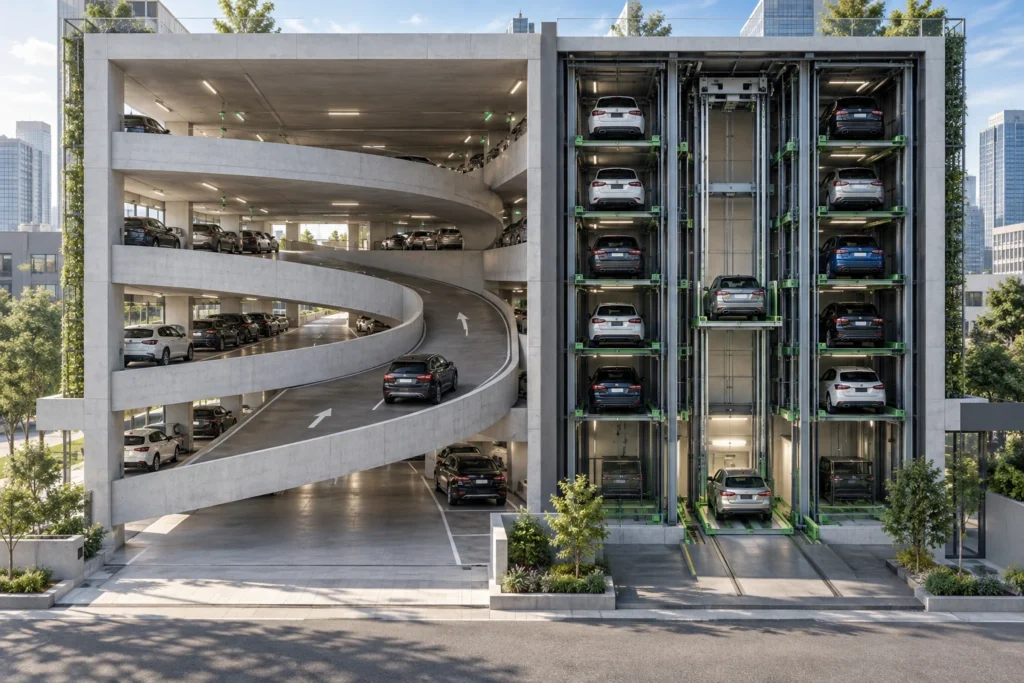
Parking has become one of the most important challenges in modern urban development.
Roughly 40% of a conventional car park is not parking. It is the ramp, the drive aisles and the turning space needed to get a driver to a bay and back out again. On a large site that is invisible. On a tight one it is the difference between the bay count working and not.
Automated parking recovers that 40% by removing the driver from the car park. The question is what recovering it costs, and what the two options cost to run once they are built.
What is conventional parking?
Conventional parking refers to the methods where drivers search for and park their own vehicles. These include:
- Surface parking lots
- Underground parking garages
- Multi-storey parking structures
- Street parking areas
In these facilities, drivers are responsible for navigating the parking area, finding a space and positioning the vehicle.
It remains the most common approach worldwide, and it requires significant space for vehicle movement:
- Driving lanes
- Turning areas
- Ramps
- Pedestrian access areas
What is automated parking?
Automated parking uses mechanical systems, sensors and control software to store and retrieve vehicles. Instead of drivers searching for spaces, cars are left at a designated entry point and the system moves them into position.
We build four types:
- Car lifts
- Pit parking systems
- Stack parking systems, also called puzzle parking
- Robotic parking systems
The key differences
The main difference is how vehicles are stored and managed. Conventional parking depends on the driver; automated parking does not.
| Feature | Conventional parking | Automated parking |
|---|---|---|
| Parking process | Drivers manually search and park vehicles | Vehicles are automatically stored and retrieved |
| Space efficiency | Requires large areas for movement and access | Maximizes space using compact designs |
| Parking capacity | Limited by conventional layouts | Higher capacity within smaller areas |
| User experience | Requires time and effort from drivers | Faster and more convenient |
| Safety | Higher risk of collisions and vehicle damage | Controlled automated environment |
| Technology | Limited smart features | Sensors, software and automation |
| Land requirements | Needs larger construction areas | Suitable for limited urban sites |
Space efficiency: which uses land better?
Conventional parking requires significant space for vehicles to move around. That is the 40% above.
Automated systems remove most of that requirement by using vertical and compact storage. This allows developers to:
- Create more parking spaces within the same area
- Reduce construction footprint
- Use smaller urban properties effectively
- Increase building efficiency
Capacity
A conventional parking structure stores vehicles based on the available floor area and the driving space it has to give up. Automated systems improve on that by:
- Using vertical space
- Removing unnecessary circulation areas
- Optimizing vehicle arrangement
- Creating compact storage configurations
In practice that is up to three times as many cars in the same footprint, compared with a conventional ramped car park on the same plot. The actual figure depends on site dimensions and system choice.
It matters most for:
- Downtown developments
- Residential towers
- Hotels
- Commercial buildings
- Mixed-use projects
User experience
Conventional parking asks the driver to:
- Search for available spaces
- Navigate crowded areas
- Walk long distances
- Deal with traffic inside the parking structure
An automated system asks them to stop, get out and walk in. Retrieval takes around 90 seconds on a pit or stack system and 90 to 180 seconds on a robotic one.
Safety and security
Conventional parking areas may experience:
- Vehicle collisions
- Unauthorized access
- Parking damage
- Poor visibility
Automated parking provides a more controlled environment. Since drivers do not enter the parking area, those risks are significantly reduced. Nobody is in the storage area while the system is running.
Cost: why the obvious comparison is the wrong one
An automated system costs more than an empty concrete deck. Comparing those two numbers is how most people reach the wrong conclusion.
The comparison that matters is cost per bay delivered — and a conventional bay is not just its slab. It carries a share of the ramp, the drive aisle, the extra basement level the ramp forced, the excavation for that level, and the ventilation and lighting a larger volume needs. Price those out and the gap narrows sharply. On a plot where land is the constraint rather than the budget, it often closes entirely.
There is one more line that rarely appears in the estimate and usually should: what the recovered area is worth. On a commercial scheme, a level not spent on a ramp is a level that can be leased. On a residential one it is a gym, a pool, or two more units.
Running costs, side by side
Capital cost is the argument people have. Running cost is the one they live with. A like-for-like list, before any figures are put against it:
| Cost line | Conventional car park | Automated system |
|---|---|---|
| Lighting | Whole deck lit whenever occupied | Sealed or enclosed storage; minimal |
| Ventilation | Sized for running engines throughout | No engines running in the storage area |
| Deck and membrane repair | Ongoing; traffic-loaded slabs | Reduced area, no vehicle traffic |
| Line marking and signage | Recurring | Not applicable |
| Security staffing / patrol | Usually required | Access controlled; no pedestrians |
| Cleaning | Whole deck | Entry bays only |
| Mechanical maintenance | Minimal | Scheduled contract — the main running cost |
| Power | Lighting and ventilation | Movement, lighting and controls |
| Floor area | Largest single cost, easiest to overlook | Substantially reduced |
The honest summary: an automated system moves cost from the invisible column to the visible one. The maintenance contract is a real, recurring, quotable number. The floor area a conventional car park consumes is a larger number that nobody ever invoices you for.
Environmental impact
Conventional parking contributes to environmental challenges through:
- Increased vehicle movement
- Higher fuel consumption
- Larger construction footprints
Automated parking supports sustainability by:
- Reducing unnecessary driving inside parking facilities
- Using land more efficiently
- Cutting the lighting and ventilation load a large open deck needs
Which is better?
Conventional parking is the better answer more often than a company that sells automated systems usually admits. Build a ramped car park when:
- Land is cheap and there is enough of it that the plot is not the constraint
- The budget cannot carry a maintenance contract for the life of the building
- There is no facilities team, and no intention of appointing one
- The peak is very large and the budget is not — throughput costs money in entry bays
Automated parking is the better choice for:
- High-density urban areas
- Limited land availability
- Luxury residential projects
- Commercial developments
- Any site where the plot, not the budget, is what the scheme is short of
Conclusion
Compare the two on cost per bay delivered, not on the price of the equipment, and count what the recovered area is worth. Where the plot is the constraint, an automated system usually wins on that arithmetic. Where it is not, it usually does not.
Send us the layout and we will run the arithmetic for your site. Request a layout review