
Every serious conversation about automated parking reaches the same question, usually near the end and usually phrased casually: what happens if it breaks?
It is the right question. A conventional car park fails gracefully — the lights go out and you can still drive your car home. An automated system holds your car inside a machine. Anyone specifying one should understand exactly what happens when that machine stops, before they sign for it.
Here is the honest version.
First: how often does it actually stop?
Two things drive stoppages, and they are not equally likely.
Wear and tear is slow, predictable and largely preventable. Chains, ropes, hydraulic seals, sensors and contactors have known service lives. They are the subject of the maintenance schedule, and a system that is serviced on schedule rarely surprises anyone.
Everything else — a power cut, a car parked badly enough to break a light curtain, a sensor knocked out of alignment, a user error at the terminal — is more common but also far more trivial. Most call-outs of this kind are resolved at the control panel in minutes, and an increasing share are resolved remotely without anyone attending site.
The systems with fewer moving parts stop less often. A car lift has very little to go wrong. A stack system has more, a robotic system more again, and that is part of the trade you are making when you choose density and software over simplicity.
What happens in a power cut
Nothing dramatic. The system stops where it is and holds.
This is deliberate, and it is the single most important safety property of the equipment. Platforms are held by mechanical locks, not by pressure or power. On a car lift, the locks engage the platform independently of the hydraulics — if pressure is lost, the platform stays where it is. On stack and pit systems, mechanical locking and interlocks do the same job. Nothing descends because the power went away.
When supply returns, the control system does not simply resume mid-movement. It re-establishes where every platform is, confirms the operating area is clear, and only then accepts commands again.
Two things to settle at design stage rather than after handover:
Do you want a car to be retrievable during an outage? For most residential buildings the answer is no — a power cut is usually short, and the building’s own standby supply covers the essentials. For a hotel, a hospital, or any building where a car may need to leave at any hour, the system should be on the standby generator or given a dedicated supply. That is a one-line decision on the electrical brief and an expensive one to add later.
Who is allowed to perform a manual recovery, and are they on site? Every system we supply has a manual release and a documented recovery procedure. It is not a difficult procedure, but it is a trained one.
What happens in a fault
A fault stops the movement in progress and locks the area. The system will not attempt to work around it.
From there the sequence is: the fault is logged and flagged, diagnosed, and either cleared remotely or attended. Because the control system records what it was doing and which sensor objected, diagnosis is usually quick — this is one of the genuine advantages of a PLC-controlled machine over a car park full of people.
The part worth asking any supplier about is what happens between the fault and the fix:
- How is the fault detected — does someone have to report it, or does the supplier see it?
- Can it be diagnosed remotely?
- What is the response time for an attendance, and is it contractual?
- Where are the spare parts held, and which parts are held?
That last question is the one that separates suppliers in this region. A control board that has to be air-freighted from Europe turns a two-hour fix into a two-week outage. We monitor our installed systems remotely — we generally see a fault on our screens before the building manager sees it — and we hold commonly required parts in Dubai rather than at a factory several thousand kilometres away.
Nobody is inside the machine
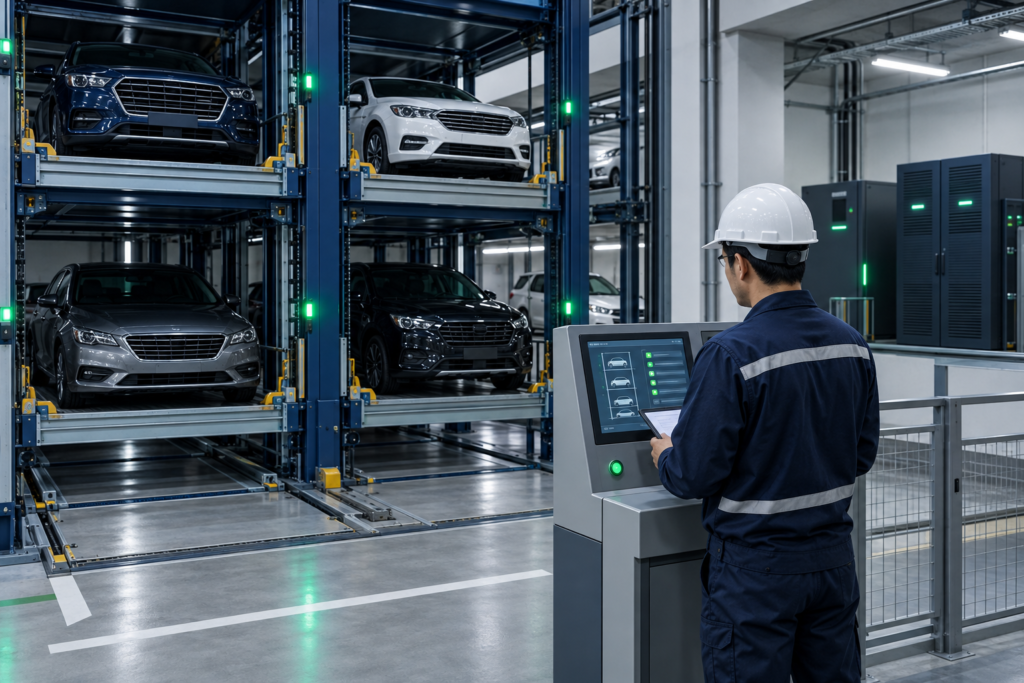
It is worth stating plainly, because it is the property that makes all of the above manageable: in a properly designed automated system, no person is ever in the parking area while it is operating.
Pit systems are sealed during operation. In stack and robotic installations the storage area is not a place people walk. Drivers step out at the entry bay and go no further. Entry is controlled by interlocks that will not allow movement while a gate is open or a light curtain is broken, and every system has an emergency stop that halts everything immediately.
So a stoppage is an inconvenience about a car. It is not a situation involving a person.
Maintenance is not optional, and it is not expensive
Automated parking is building plant, in the same category as lifts, chillers and generators. It is maintained on a schedule, by people who are trained on it, and it behaves well when that happens.
A reasonable regime covers:
- Scheduled preventive visits at defined intervals, with a written checklist
- Inspection and adjustment of chains, ropes, hydraulics, locks and sensors
- Verification of every safety device — interlocks, light curtains, emergency stops, overload protection
- A test of the manual recovery procedure, so that it is known to work rather than assumed to
- A written report after each visit, with anything approaching end of life flagged before it fails
Against the running costs of a conventional car park of the same capacity — the lighting, the ventilation, the deck maintenance, the security staffing, and the floor area itself — a serviced automated system compares well. The cost is simply more visible, because it arrives as an invoice rather than as space you never notice you are paying for.
What to ask before you commit
Put these to any supplier, including us:
- What holds the platform if power or hydraulic pressure is lost?
- Is remote monitoring included, and does the supplier see faults before we report them?
- What is the response time for an attendance, and is it written into the contract?
- Which spare parts are held locally, and where is “locally”?
- Who performs manual recovery, and will our building team be trained and issued the procedure?
- Does the system need to run on the standby generator? What does that add?
- What does the maintenance contract cover, at what interval, and what is excluded?
- Who will still be here to service this in ten years?
The last one is the real question. Automated parking systems are long-lived equipment. The relevant risk is not that the machine will fail — it is that the company that supplied it will not be reachable when it does.
The next step
If you are weighing an automated system and the reliability question is the one holding it up, we are happy to walk through the recovery procedures and the service scope for the specific system you are considering, before there is a price on the table.