
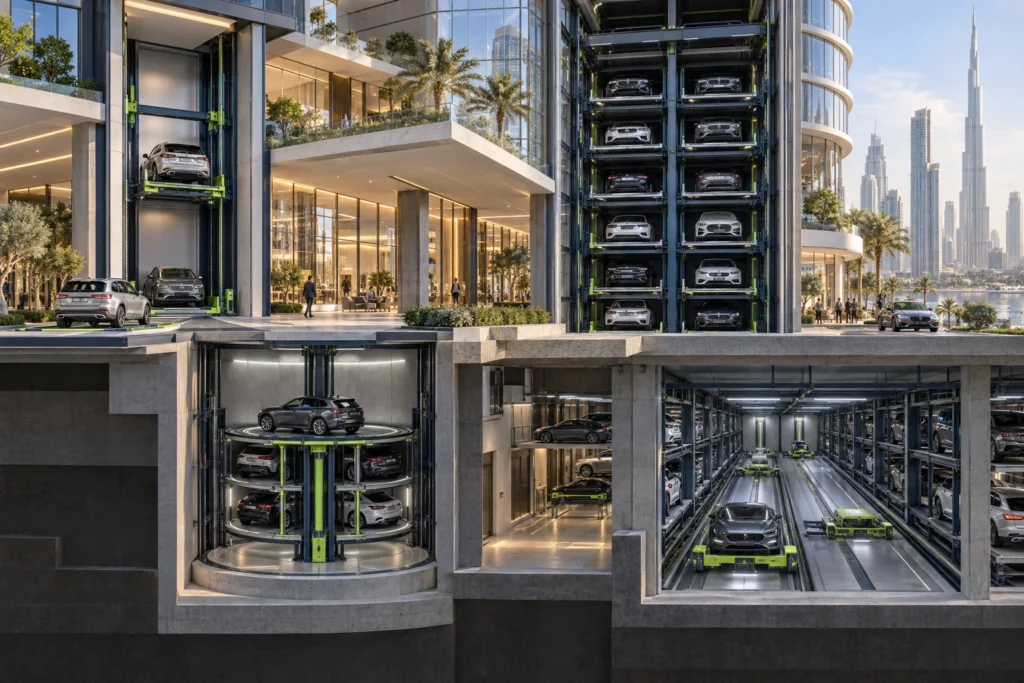
Most people arrive at automated parking with a number in their head — the bays they are short by — and no clear view of which type of system delivers them. The four categories we build are not four grades of the same product. They solve different problems, at different costs, on different sites.
This guide is the short version of the conversation we have with clients before anything is drawn.
Start with the site, not the system
Four things decide most of the answer, and all four are properties of the building rather than the equipment:
Clear height. How much room is there above the bay, floor slab to underside of slab or services? A car lift needs enough for two cars. A stack system needs enough for the number of levels you are after.
Depth you can dig. Excavation is the expensive variable. Rock, a high water table, existing foundations, or a services corridor under the plot can move a pit from straightforward to unaffordable.
Plan shape. A clean rectangle suits a stack layout. An L-shaped plot, an irregular basement or a leftover pocket of floor area is where a robotic system earns its cost.
Peak retrieval demand. Twelve villas leaving over an hour is not the same problem as four hundred cars leaving a venue in fifteen minutes. Capacity is easy. Throughput at the peak is what decides the number of entry bays and the system type.
Bring those four to the first conversation and most of the shortlist writes itself.
Car lifts: two or three cars where one used to sit
The simplest thing we build. A platform lifts one car so a second can park underneath.
Choose it when the requirement is small and the ceiling is already there. Villas, small residential buildings, workshops and showrooms are the typical cases. Most units go in over a weekend with little or no civil work, which matters if the building is already occupied.
Typical planning figures: about 60 seconds up or down; platform loads from 2,000 kg; cars, SUVs and pickups up to roughly 2,050 mm high.
It is the wrong answer when you need more than a handful of extra bays, or when you want unattended operation. A car lift is operated deliberately, by the person using it.
Pit parking: capacity you cannot see
Pit systems put the cars below ground and keep the surface clear. Nothing is visible at grade — no parked cars, no ramps, no open decks.
Choose it when the ground plane is worth more than the parking. A villa that should read as garden rather than driveway. A hotel forecourt. A building with a height restriction, where taking parking down rather than up buys you a storey above ground.
Typical planning figures: 2 to 5 levels, 2 to 15+ cars, pit depths of 3.5 to 6.5 metres, around 90 seconds to retrieve.
The constraint is always the excavation. Confirm ground conditions, the water table and the position of existing foundations and services early — a soil report costs very little compared with redesigning around a surprise.
Stack parking: the workhorse
Cars sit on platforms that move up and sideways, across anything from two to sixteen levels. For most mid-sized projects on a regular plan, this is the system that gives the best capacity for the money.
Choose it when you need real capacity — tens to a couple of hundred bays — on a site with a reasonably regular shape, and when low maintenance matters more than the last ten per cent of density. It has fewer moving parts than a robotic system, which is exactly why it is easier to live with over twenty years.
It also retrofits. An existing basement or podium can often take a stack system with limited structural work, which makes it the usual answer when a completed building has a parking shortfall.
Typical planning figures: 2 to 16 levels, 2 to 200+ cars, platform loads of 2,000 to 2,500 kg, around 90 seconds to retrieve.
Robotic parking: density on a difficult plot
Shuttles lift each car from underneath and carry it sideways and up. There are no pallets to store or move, so more of the structure holds cars rather than empty trays.
Choose it for the hard cases: large capacities, irregular or L-shaped footprints, low headroom, or a brief where the parking has to disappear entirely and the site will not cooperate with anything simpler. It is also the system to look at when the peak is severe, because shuttles work in parallel and several cars can be moving at once.
Typical planning figures: 20 to 500+ cars, vehicles up to about 5,200 × 2,100 × 2,100 mm and 2,500 kg, retrieval of roughly 90 to 180 seconds depending on configuration.
It carries the highest capital cost of the four and the most software. That is a fair trade on a site where nothing else fits, and a poor one on a rectangular basement that a stack system would have handled.
A quick way to narrow it down
| If this is true | Start here |
|---|---|
| You need 2 or 3 bays and the ceiling is already high enough | Car lift |
| The surface has to stay clear and you can excavate | Pit parking |
| You need real capacity on a regular plan, new build or retrofit | Stack parking |
| The plot is irregular, the headroom is tight, or the peak is severe | Robotic parking |
| You are not sure which of the last two applies | Send the layout — it is usually visible in ten minutes |
What the figures in this guide mean
The numbers above are planning values, not quotations. Capacity, retrieval time and depth all move with the actual site: bay geometry, structural grid, clear height, vehicle mix and how many cars have to move at once. Comparisons to “up to three times more capacity” are against a conventional ramped car park on the same plot.
Anyone who gives you a firm figure before seeing a drawing is guessing.
The next step
Send us the layout — a basement plan or a site plan is enough to start. We will tell you which systems the site will actually take, roughly how many bays each one yields, and what would have to be confirmed before anything is priced.